
This post is the an inaugural entry on my attempt for a multi-part series on digital learning twins. While I have the aspiration to write at least four posts with pertinent perspectives toward such matter and related concerns, I will defer to the availability of my remaining semester and the lucky few nights when my 1.5-month-old isn’t fussy.
I am always curious and somewhat critical about technological augmentation. As an educator and researcher, I have noted how tools and devices extend our human capacity (yes, you’re right to smell McLuhanism here) in our personal and professional lives. As the world has observed, recent developments in generative AI opened a sizable sphere for debates and deliberation about the future of teaching and learning given the disruption it promises to conventional content creation and information processing. But sometime this autumn, just about three full years into our heated discourse, the AI assistant as we know it stopped waiting to be asked. Within about six weeks, Meta released Muse, OpenAI released dots, and Anthropic opened a research preview of Claude Duet. The three products serve different audiences and draw their guardrails in different places. What they share is an unprecedented premise. Each agent keeps working after you close the app, remembers what you have told it, and reaches out on its own when it decides something needs your attention.
Engineers would recognize that premise. An agent that maintains a persistent, updating model of a person and acts on it is functionally a digital twin. As these agents make their way into classrooms, workplaces, and the long middle of people’s careers, I think educators need a theory of the digital learning twin before the products settle the question for us. So, this series is my attempt to begin one. Its central claim may sound backwards at first. A learning twin succeeds when the learner outgrows it.
Where (digital learning) twins come from
Digital twins began in engineering. Michael Grieves introduced the concept in 2002 as part of product lifecycle management, and NASA’s John Vickers gave it its name in a 2010 technology roadmap (Britannica). A twin is a virtual model of a physical object, fed by real-time data and kept in sync so that engineers can monitor, predict, and test without touching the real thing.
In that world, a good twin is a faithful one. A jet engine’s twin earns its keep by tracking the engine closely, and any drift between the two signals a problem with the model. The engine is never meant to become something else, and the twin’s job is to report when it starts wearing out.
Carried over into personal AI, that logic sounds like a selling point. The more closely an agent models you, the better it can anticipate what you need, and anticipation is precisely what this fall’s proactive agents are marketing.
Learning unsettles that logic. People learn in order to change, which puts a learner in a very different relation to a model than an engine. If a learning twin could predict me perfectly, I would have to wonder whether I had stopped learning or whether the twin had begun nudging me toward staying predictable.
That second possibility is what worries me most about proactive agents. An agent that keeps anticipating my next move can gradually narrow the moves I make. For a learning twin, then, drift is the goal, and a well-designed twin would notice when I had outgrown its picture of me and count that as success.
Reading the twin through 虛實
My recent work has taken me down the road of classical Chinese philosophy as a lens for the modern condition. Particularly, the concept of 虛實 (xū shí) helps me think about digital simulations better than engineering vocabulary does. 虛 refers to the empty, the virtual, and the suggested, and 實 to the solid, the actual, and the present. In classical painting, calligraphy, and garden design, the two depend on each other, and empty space does real work in a composition.
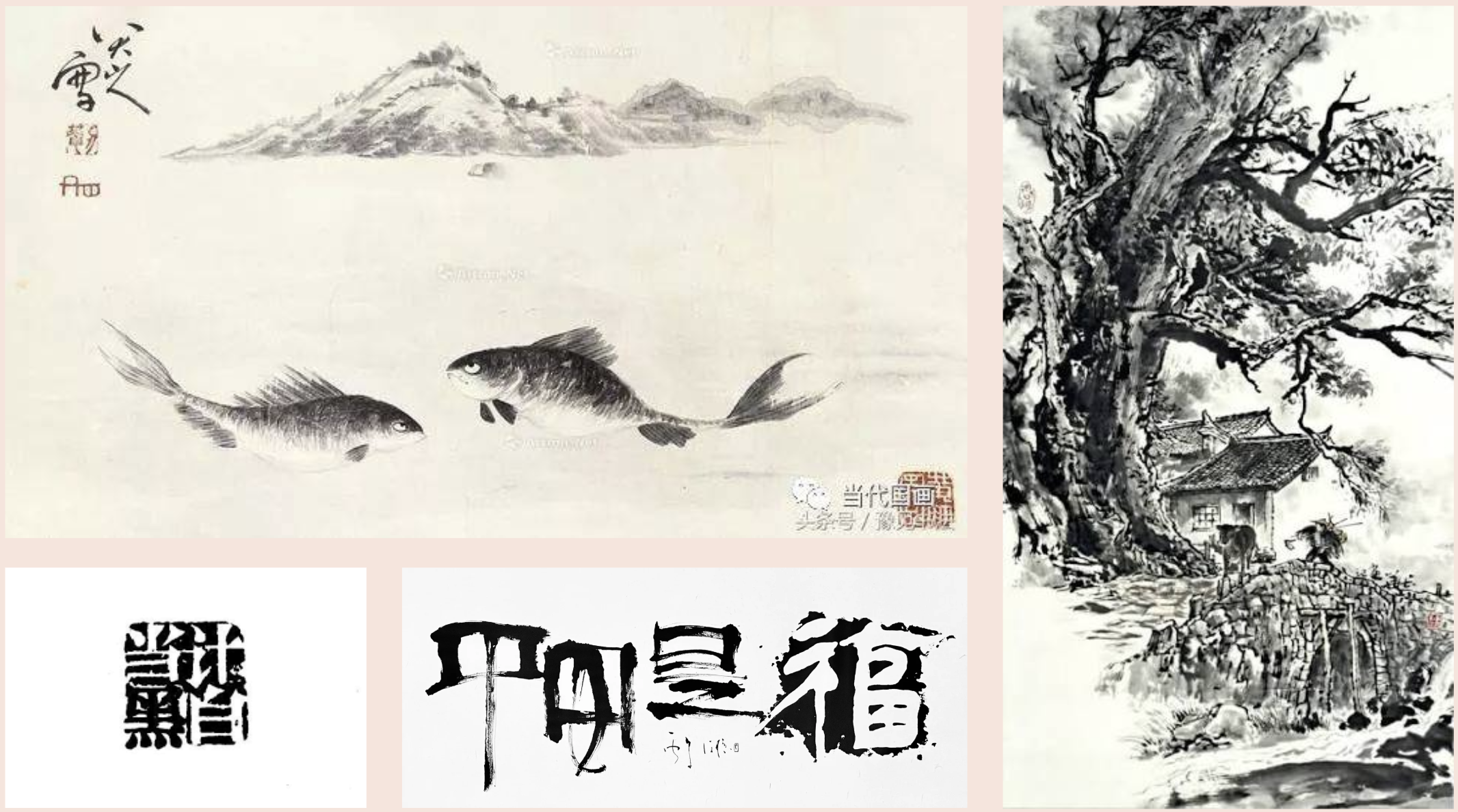
If the twin is 虛 and the learner is 實, the question worth asking is whether their relationship leaves room for the learner to become something the model does not yet contain. Painters have a term for leaving that room on purpose, 留白 (liú bái), and I think a good learning twin practices it too. If you’re curious to see how this concept applies also to technical communication practices, particularly interface design, you may check out my recent presentation to the Council of Programs in Technical and Scientific Communication (CPTSC) conference audience about such application––view slideset here.
Twins as brokers and the questions of ownership
Connected learning research gives this idea a practical footing. Mizuko Ito and colleagues (2013) describe learning that links personal interests, peer culture, and academic life, and that points toward educational, economic, or civic opportunity. Their central concern is disconnection. What people learn through their interests rarely counts in school, and what counts in school too often fails to lead anywhere.
Ito’s team studied young people, yet the same disconnection shapes the lives of adult learners. A learning twin could serve as a broker across those spheres. It might notice that a project at work, a course assignment, and a weekend interest all exercise the same skill, and help the learner carry that skill from one setting into the next.
Seen this way, a twin earns its value through the connections it helps a learner make. The people with the most to gain are those whose learning is already scattered across contexts, including working adults, career changers, and students returning after years away.
Connectivism as a theory pushes the idea further. George Siemens (2005) argued that learning increasingly happens across networks of people, organizations, and tools, and that knowing where to find knowledge has come to matter as much as knowing it. He also observed that for many people, learning and work have become nearly impossible to pull apart. Stephen Downes (2012) takes the theory toward epistemology, describing knowledge as distributed across a network of connections and learning as the ability to build and move through those networks. In his account, healthy learning networks share a few properties, among them autonomy, diversity, and openness.
Read alongside these two, a learning twin looks like a new kind of node in a learner’s network, one that can surface connections the learner has not yet noticed. Downes’s criteria also suggest how to judge it. A twin earns its place when the learner becomes more capable of building and traversing connections on their own. If the learner’s network begins to run through a single vendor’s model, the twin has worked against the very autonomy Downes describes.
Any connector that links my job, my coursework, and my personal life can also see across all three. That is a great deal of access to grant an agent built by a company with interests of its own. Critical digital literacies teach us to ask who benefits from that access and on what terms.
For a learning twin, those questions become concrete. Can a learner take the twin along when they leave a school or a job? Whose idea of progress is built into it, and who decided? Can the learner inspect the model and argue with it? And who else gets to look, whether an employer, an institution, or a vendor? I raise these questions as design requirements. A learning twin worth building would have answers to them from the start.
What comes next
The next three posts follow the learning twin into three settings. The first turns to leadership. Institutions already keep twins of their students in dashboards and predictive models, and I will argue that deliberative restraint begins with remembering that the model and the student are different things.
The second takes up design, drawing on early wearables research and on what design thinking can offer when the thing being designed is a model of a person. The third considers working learners, the adults learning across jobs, courses, and families who have the most riding on how these twins are built.
I am also beginning a comparative study of proactive agents as learning twins and will share more as that work takes shape. Until then, I would like to hear from teachers, program leaders, and learners. Where would a twin help you, and where would you want it to stop?
Sources and further reading
- Meta debuts Muse, its long-planned personal AI agent, Axios, September 8, 2026
- OpenAI launches dots, always-on AI agents in ChatGPT, SiliconANGLE, September 29, 2026
- Claude Duet: Anthropic previews an AI agent that messages you first, VKTR, October 2026
- Digital twin, Encyclopaedia Britannica
- Ito, M., et al. (2013). Connected Learning: An Agenda for Research and Design. Digital Media and Learning Research Hub.
- Siemens, G. (2005). Connectivism: A learning theory for a digital age. International Journal of Instructional Technology and Distance Learning, 2(1).
- Downes, S. (2012). Connectivism and Connected Knowledge: Essays on Meaning and Learning Networks. National Research Council Canada.
Banner image featured photo by Matt Antonioli on Unsplash.

